
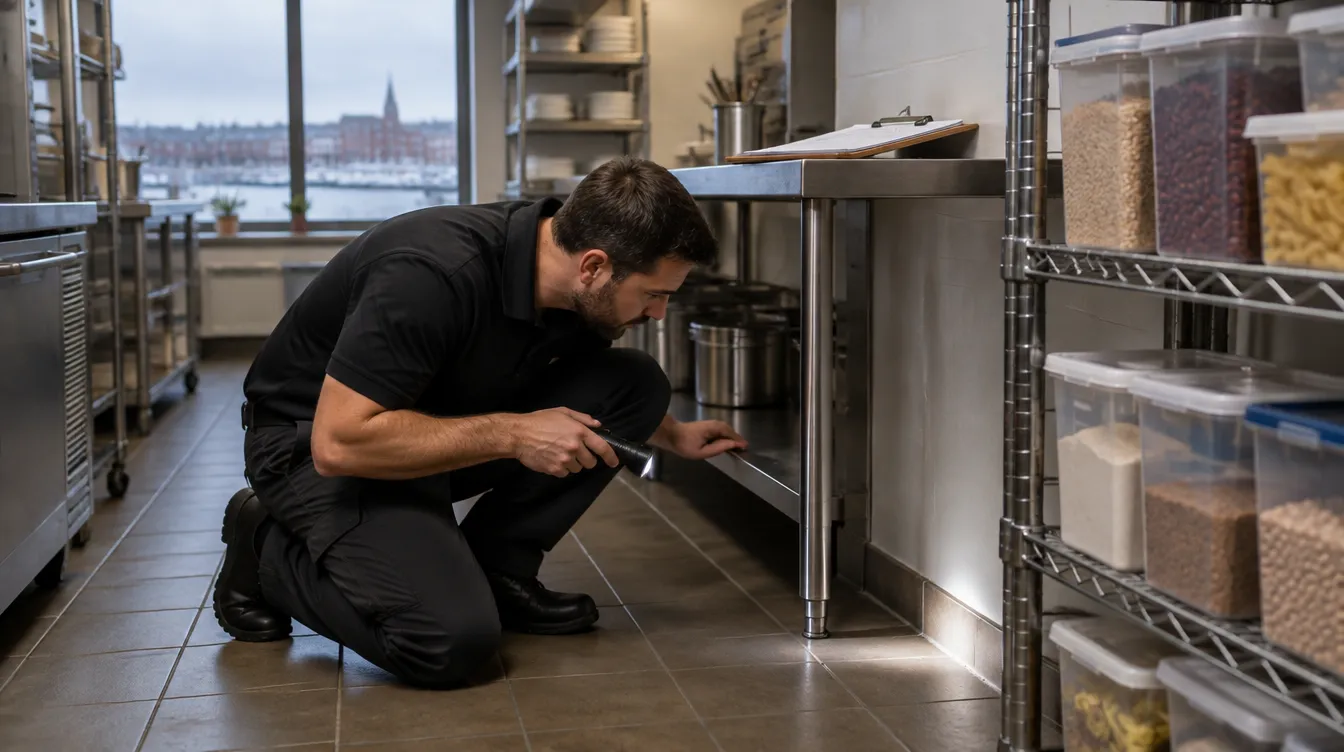
The first hard frost in Greater Portland usually lands in the last week of October or the first week of November. Within a few nights of it, the mice that spent the summer in the alley behind Fore Street, in the brush along the Westbrook rail trail or under a dumpster pad in South Portland are looking for a warm building with food in it. A restaurant kitchen is the best option they will ever find.
This guide is for owners, chefs and managers of restaurants, cafes, bakeries, bars, breweries and commercial kitchens from the Old Port out to Gorham and Windham. It covers what to seal and clean in the next few weeks, how to keep records a health inspector will accept, and what a pest control program for a food-service business in Maine actually involves through the winter.
Why winter is the hard season for Maine kitchens
In summer, pests in a Portland restaurant are mostly flies and the occasional ant trail, and the back door is open half the day anyway. Winter is different. Mice and rats come in with the cold and stay, because a kitchen offers heat from the line and the dish machine, water from floor drains and condensate lines, and food in every form from dry storage to the grease trap. German cockroaches, which arrive in deliveries rather than through the wall, breed faster in a warm kitchen than almost anywhere else.
A few things about the local building stock make it worse:
- Many Old Port, West End and Munjoy Hill restaurants are in brick and timber buildings from the 1800s with shared basements, old coal chutes and utility penetrations that were never sealed.
- Strip-mall and plaza locations in Westbrook, Scarborough and South Portland share walls, ceiling plenums and dumpster enclosures with their neighbours, so one tenant's problem becomes everyone's.
- Waterfront buildings on Commercial Street sit over fill and piers, which rats use freely.
- Seasonal volume drops after Columbus Day, so the back of house is quieter, deliveries are fewer and a sign of activity is easier to miss for a week.
What a health inspector looks at
In most of Maine, eating establishments are licensed and inspected by the Maine CDC Health Inspection Program; the City of Portland runs its own inspection program for restaurants inside city limits. The inspection form in both cases includes pest presence and pest control as a line item, alongside food temperatures, hand washing and sanitising. An inspector is not looking for a mouse. They are looking for the evidence a mouse leaves and for whether the operator is on top of it.
The places that get checked first are predictable:
- Dry storage. Droppings on shelves, gnawed bags of flour, rice or sugar, and cardboard cases stored on the floor.
- The receiving door and loading area. Daylight under the door, a missing sweep, a door propped open for deliveries, and grease or debris outside it.
- Under and behind the line. Fryers, flat tops, reach-ins and the dish machine, where warmth, moisture and food debris meet.
- Waste and grease areas. Dumpster pads, grease bins and the path between the kitchen and the enclosure.
- Floor drains and mop sinks. Drain flies and fruit flies breed in whatever is left in them.
- Your records. Service reports, a pest sighting log and proof that anything found was followed up.
A kitchen that is clean, sealed and documented can have a mouse get in during a cold snap and still pass, because the inspector sees a monitoring device, a logged sighting and a service visit. A kitchen with no records and droppings behind the reach-in is a different conversation. Questions about licensing and inspection schedules should go to the inspection program itself; this article is about the pest side.
The pre-winter checklist for the back of house
Do this before the end of November. Most of it takes one slow afternoon with a flashlight, a caulk gun and a roll of copper mesh.
Outside and at the doors
- Stand inside the receiving door with the lights off and look for daylight. Any gap a pencil fits through is a mouse door. Fit or replace door sweeps and weatherstrip, and have a rodent-proof brush or steel sweep on the door that gets propped open for deliveries.
- Walk the exterior wall at ground level. Seal pipe, gas, cable and refrigeration-line penetrations with copper mesh packed in and sealant over it. Foam alone is chewed through in days.
- Check that the dumpster enclosure gate closes, lids close, and the pad is hosed down. Ask the hauler for a leaking container to be swapped out.
- Move pallets, stacked cases, old equipment and bags of ice-melt at least a few feet off the back wall.
Dry storage and the walk-in
- Get every case up off the floor and a few inches off the wall so the perimeter can be seen and swept.
- Decant flour, sugar, rice, grains, nuts and dried fruit into sealed, labelled bins. Open paper and plastic bags are the single most common thing we find chewed.
- Pull the lowest shelf and look at the wall-floor joint behind it. This is where droppings and rub marks show up first.
- Check the walk-in door gasket and the floor sweep on the walk-in door; condensation and the gap under it attract both rodents and flies.
The line, dish pit and drains
- Pull the line out on a closed day and clean the floor and wall behind every piece of equipment. Degrease the casters and the legs.
- Brush and flush every floor drain, and scrub the mop sink and the mop bucket. Pour-in drain treatments only work on a drain that has been cleaned first.
- Seal the gap where the dish machine drain and water lines go through the wall or floor.
- Empty, clean and dry the bar's drip trays, soda gun holsters and the beer line drain every night through the winter; these are the fruit-fly nurseries.
Deliveries
- Break down cardboard at the door and get it out of the building the same day. Corrugated cardboard is where German cockroaches ride in and where mice nest.
- Look inside produce cases and at the glue seams of cardboard before they go into storage. A single egg case the size of a grain of rice is a few dozen cockroaches in a month.
Keeping records an inspector will accept
Robbins Pest Services holds a Maine Commercial Master Applicator license (CMA-6319), and every commercial customer gets an on-site logbook that is updated at each visit. For a restaurant it should hold four things, kept together where the manager on duty can put a hand on it:
- Service reports from each visit, listing what was inspected, what was found, what was applied and where, and the applicator's license number.
- A device map showing where every monitoring station and trap is, numbered so a station can be checked and the result written down.
- A sighting log that staff fill in: date, time, what was seen, where, and who was told. Train the closing crew to use it. An empty log in a busy kitchen looks worse to an inspector than an honest one.
- Corrective actions: what was done after each sighting, with the date. A sealed hole, a swapped dumpster, a repaired sweep.
This is the same logbook structure we use for property managers and for lodging, and it is what a buyer, a landlord or a franchise auditor will ask to see as well as the inspector.
What a winter restaurant program looks like
A food-service program in Greater Portland is built around inspection and monitoring, with sealing and treatment where they are needed, rather than a spray on a schedule. Through the winter that usually means:
- A full interior and exterior inspection in November, with entry points written up in priority order and the ones within scope sealed on the visit
- Numbered monitoring stations in dry storage, behind the line, in the basement and at the receiving door, read and logged at every visit
- Scheduled visits at a frequency set by the kitchen's risk, with the schedule in the logbook, and a call-out when staff log a sighting between visits
- Targeted treatment for cockroaches or drain flies in the specific harbourage, timed around service so nothing is applied in an open kitchen
- A written report after each visit and a short list of things for the kitchen team to fix before the next one
Mice and rats are handled by trapping and sealing together; the rodent control page explains why one without the other does not hold. The restaurant pest control page covers how the program is set up for cafes, bakeries, bars and breweries as well as full-service restaurants, and the commercial pest control page covers multi-site operators.
Where this applies in Greater Portland
The density of restaurants in Portland, from the Old Port and Commercial Street through the Arts District to Washington Avenue, means a problem in one basement is quickly shared with the neighbours, which is why our guide to mice in multi-tenant buildings is worth a read for anyone in a shared building. Seasonal kitchens at inns and lake lodges around Sebago, Naples and Bridgton have a different problem, the closed building, covered in our closing-for-the-season checklist. Breweries and taprooms in Portland, Westbrook and Gorham tend to have fruit-fly and drain-fly pressure year round and a rodent push in November like everyone else.
If you would like the November inspection done before the first real cold, you can request a commercial assessment for one kitchen or several. The assessment is free, and you receive a firm quote before any work starts.
Frequently asked questions
When should a restaurant in Greater Portland do its winter pest prep?
Before the end of November. Mice start moving indoors with the first frosts in late October and early November, and sealing is far more effective before they are inside than after. If you are reading this in December, it is still worth doing; the inspection just starts with finding what already came in.
Will a mouse sighting fail my health inspection?
Not by itself. Inspectors look at the whole picture: whether the kitchen is clean and sealed, whether there is a monitoring program, whether the sighting was logged and whether something was done about it. Droppings in dry storage with no records is the combination that causes trouble. Questions about how violations are scored should go to the inspection program that licenses your establishment.
What records should I be able to show an inspector?
Service reports from each visit with the applicator's license number, a map of the monitoring devices, a sighting log that staff actually use, and a note of what was done after each sighting. Robbins Pest Services keeps all of this in an on-site logbook for every commercial customer.
Can treatments be done while the kitchen is open?
Inspection and monitoring can. Any treatment is scheduled around service, usually before opening or on a closed day, and is targeted at the specific harbourage rather than applied across a working kitchen.
We have fruit flies all winter. Is that a pest control problem or a cleaning problem?
Usually both. Fruit flies and drain flies breed in floor drains, mop sinks, bar drip trays and the residue under equipment. Cleaning those out removes the breeding sites; treatment deals with the adults and anything left in the drain. One without the other brings them back in a week.
How is restaurant pest control priced?
By the size and layout of the kitchen, the condition of the building, the visit frequency the risk calls for, and whether sealing work is included. The assessment is free, and you receive a firm quote before any work starts.