
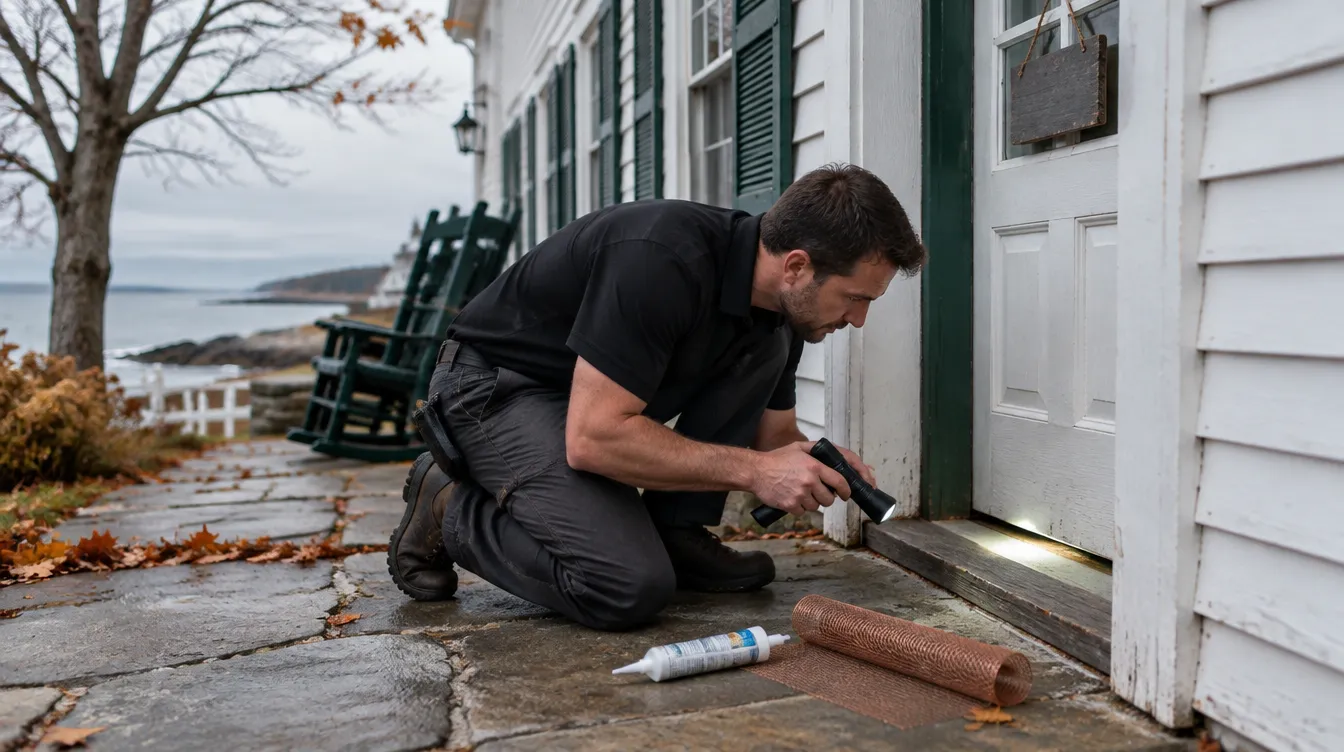
By the end of October most seasonal inns, bed and breakfasts and lake-house rentals in Greater Portland have served their last breakfast of the year. The rockers come off the porch, the water gets shut down in the outbuildings, and the owner goes home. Then the building sits for five or six months with the heat turned low, nobody opening doors, and nobody noticing what moves in.
That empty stretch is when seasonal lodging gets most of its pest problems, and the problems are found in May, a week before the first guests. This checklist is written for innkeepers and seasonal rental owners from Cape Elizabeth and the Old Port out to Sebago Lake, Naples and Bridgton. It covers what to do in the last week before you close, and what a closing inspection actually looks at.
Why a closed inn is such an easy target
An occupied inn is a hard place for a mouse to live. Doors open and close all day, floors are vacuumed, kitchens are wiped down every night, and a dozen people would notice droppings on a windowsill. Close the building and every one of those pressures disappears at the same moment the nights turn cold.
A few things make Maine's seasonal properties especially easy to get into:
- Age. Many of the region's inns are nineteenth-century houses with fieldstone foundations, bulkheads and porches that were added later and never sealed underneath.
- Outbuildings. Carriage houses, guest cottages, sheds and boathouses are rarely inspected and are usually connected to the main house by a path mice are happy to use.
- Low heat. A building kept at 50 degrees is still warmer than a field in January, and a water heater closet or furnace room is warmer still.
- Stored linens and soft furniture. Mattresses, upholstered chairs and folded bedding are nesting material to a mouse and a hiding place for anything that arrived in luggage in September.
- Food left behind. Breakfast pantries, bar snacks, bird seed on the porch and the half bag of dog food in the owner's quarters are a winter's supply for a mouse family.
What gets in while you are away
Over a Greater Portland winter, four problems account for nearly everything we find at seasonal properties in the spring:
- Mice. The most common by far. They enter at the foundation in October and November, nest in stored bedding, drawers and wall voids, and chew wiring and insulation. A single pair in November is a family of dozens by April. Our fall rodent exclusion guide explains how they get in and how sealing works.
- Overwintering insects. Cluster flies, western conifer seed bugs and ladybugs crawl into attics and south-facing wall voids in October. They do no damage, but a guest room full of sluggish flies on a warm March day is a bad first impression at reopening.
- Bed bugs that came in with the last guests of the season. They do not need a host to survive the winter. A small introduction in a September room can sit dormant in a headboard and be active again when the first guests arrive in spring.
- Carpenter ants. A colony that found a damp sill or porch post in summer is quiet in winter and swarms indoors in March and April, often before the building is fully opened.
Termites are rare in Maine, and the wood-damaging insect an innkeeper here should worry about is the carpenter ant. The lodging page on our site covers how pest control for hotels, inns and short-term rentals is organised through the season; this article is about the closing.
The last-week checklist
Work through this in the final week of operation, after the last checkout and before the building is locked:
Kitchen, breakfast room and bar
- Remove every open or paper-packaged food item from the building: flour, cereal, crackers, granola, sugar, tea, pet food and bird seed. Sealed cans and glass jars can stay.
- Empty, clean and prop open refrigerators and freezers that are being switched off.
- Clean floor drains, under and behind cooking equipment and inside the dishwasher. Drain flies breed in whatever is left.
- Take all trash and recycling off the property. Do not leave a bag in the mudroom for the spring.
Guest rooms
- Strip beds. Launder bedding on hot and store it in sealed plastic bins, not open shelves or dresser drawers.
- Inspect each mattress seam, box spring and headboard with a flashlight before covering it. Encased mattresses are easier to check in spring.
- Pull nightstands and headboards a few inches from the wall and look behind them. This is where an introduction from the last guests of the season shows up first.
- Leave closet doors and dresser drawers open so there is nowhere dark and undisturbed to nest.
Exterior and foundation
- Walk the whole foundation with a flashlight, including under porches and additions, and mark every gap wider than a pencil.
- Check that every exterior door, bulkhead and cellar window closes fully and has an intact sweep or weatherstrip.
- Seal around pipe, cable and dryer-vent penetrations with copper mesh and sealant or mortar. Expanding foam alone is chewed through in a week.
- Move firewood, lumber and stacked deck furniture at least a few feet off the foundation. Stacked cushions against the house are a mouse hotel.
- Cut back shrubs and vines that touch the siding, and clear leaves from window wells.
- Do the same walk at every outbuilding, and make sure none of them has a food source of its own.
Attic, basement and mechanical rooms
- Check gable vents, soffit vents and the chimney cap for intact screening.
- Clear stored items a foot away from basement walls so the perimeter can be seen at the closing inspection and again in spring.
- If the heat stays on at a low setting, note which rooms will be warmest. That is where monitoring belongs.
What a closing inspection covers
A closing visit is one of the two most useful service visits a seasonal property can have, and it is short compared with the work of clearing an infestation in May. For an inn in Greater Portland or the Lakes Region it usually includes:
- A full exterior and foundation inspection, with the entry points written up in priority order and sealed where that is within the scope of the visit
- A room-by-room check of beds, headboards and upholstered furniture for bed bug evidence before rooms are closed up
- Monitoring devices placed in the basement, mechanical rooms, kitchen and the warmest areas of the building, mapped so they can be checked over the winter or at opening
- An inspection of attics and wall voids on the sunny sides of the building for overwintering insects, with treatment of entry points where it is warranted
- A written report of what was found, what was sealed and what the owner or caretaker should do before spring
Robbins Pest Services holds a Maine Commercial Master Applicator license (CMA-6319), and every commercial customer receives a logbook that stays on site and is updated at each visit. For a seasonal inn the logbook is the closing report, the device map and the opening findings in one place, which is what a new manager, a buyer or an inspector will ask to see.
Mid-winter check-ins and the opening visit
If a caretaker is already visiting the property to check pipes and heat, a monthly walk past the monitoring devices with a flashlight is enough to catch a problem early. If nobody is visiting, one mid-winter service visit in January or February is worth considering for larger properties and for any building that had activity the previous year.
The opening inspection in April or May then becomes a confirmation rather than a surprise: devices are read, rooms are re-checked before they are made up, and anything that did get in over the winter is dealt with weeks before the first reservation. Properties that get the closing visit, the monitoring and the opening visit rarely need anything more during the season than a scheduled rotation through the guest rooms.
Where this applies in Greater Portland
The inns and B&Bs of the West End and the Old Port mostly stay open through the winter, and their issue is the fall rodent push rather than a closing. The properties this checklist is written for are the shoreline inns and guest houses in Cape Elizabeth, Scarborough and Falmouth, and the lake lodges, camps and rental cottages around Sebago Lake, Raymond, Naples and Bridgton, most of which close between Columbus Day and Thanksgiving and reopen for Memorial Day.
If you run a breakfast kitchen or a restaurant on the property, our restaurant pest control page covers how the kitchen side of the program works, and for an active mouse problem the rodent control page explains how trapping and sealing go together. You can request a commercial assessment for one property or several. The assessment is free, and you receive a firm quote before any work starts.
Frequently asked questions
When should a seasonal inn have its closing pest inspection?
In the last week before the building is locked, after the final checkout and after the kitchen has been cleared of open food. In Greater Portland that is usually between mid-October and mid-November. Later is still worthwhile, but the first cold nights are when mice start looking for a way in.
We turn the heat down to 50 degrees. Does that keep pests out?
No. A building at 50 degrees is far warmer than the outdoors in January, and furnace rooms and water heater closets are warmer still. Low heat slows insects down but it does not stop mice, which are the main winter problem for seasonal properties.
Should we leave mouse traps or bait out when we close?
Monitoring devices placed and mapped by a licensed applicator are useful, because they tell you at opening whether anything got in and where. Loose consumer bait left around an unoccupied building is a poor idea: it is a hazard to pets and wildlife, and a mouse that dies inside a wall is a worse problem in May than a live one.
Can bed bugs survive in a closed inn over the winter?
Yes. Bed bugs can go months without feeding and tolerate cool indoor temperatures. A small introduction in one of the last rooms of the season can be active again when the first guests arrive, which is why each room is checked before it is closed up.
Do you inspect guest cottages and outbuildings as well as the main house?
Yes. Cottages, carriage houses, sheds and boathouses are often where a problem starts, because they are the least visited buildings on the property. A closing inspection covers every structure that will be used by guests or staff.
How is a closing inspection for a seasonal property priced?
By the number of buildings and rooms, the condition of the property and whether monitoring and sealing are included. The assessment is free, and you receive a firm quote before any work starts.