
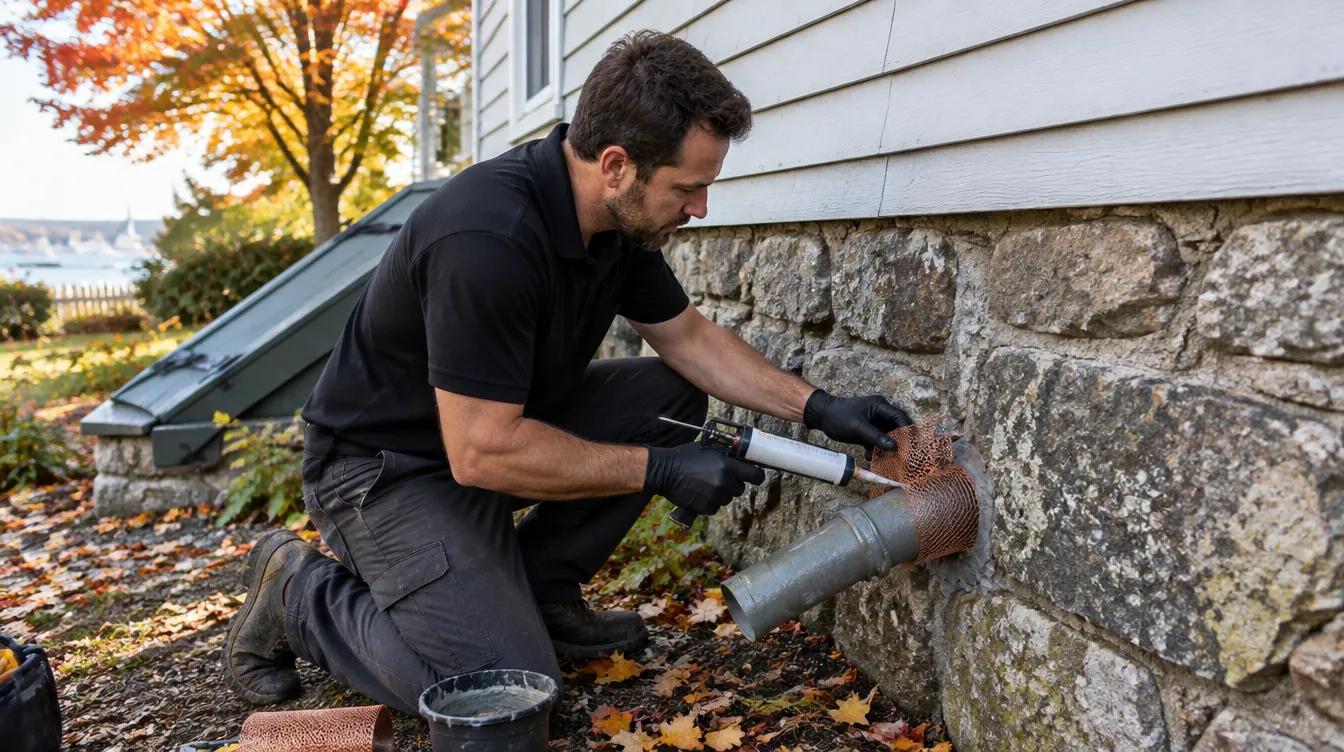
Every fall, the same thing happens across Greater Portland. The first few nights in the 40s arrive in late September, and within a couple of weeks the calls start: scratching in the ceiling on Munjoy Hill, droppings under a kitchen sink in Deering, a mouse in the basement of a 1920s bungalow in Westbrook. Mice and rats do not wait for winter. They move in during the six weeks between the first cold nights and the first hard frost, which in Cumberland County usually means late September through early November. Rodent exclusion, the work of finding and sealing the gaps they use, is the single most effective thing you can do for your house this time of year, and it works best when it is done before the animals are already inside.
Why September and October are the deadline
Mice and Norway rats spend summer outdoors where food is easy. As temperatures fall and the seed and insect supply thins, they follow warmth and smell toward buildings. A house mouse needs a gap about the width of a pencil, a quarter inch, to get in. A young rat fits through a half-inch hole. Once inside, they nest in insulation, wall voids and the back corners of basements, and a single pair of mice can produce dozens of offspring before spring. Exclusion done in September keeps them out. Exclusion done in December has to start with trapping first, which means more visits and more cost. This is the busiest season for our rodent control team.
Where mice actually get in around Portland
The building stock in Greater Portland is old, and old houses have predictable weak points. These are the ones we find most often on inspections.
- Sill plate and foundation gaps. Fieldstone and rubble foundations in the West End, Munjoy Hill, Bayside and older parts of South Portland are full of voids where mortar has weathered out. Even poured concrete foundations from the 1950s and 60s in Deering and Scarborough often have a gap between the top of the wall and the wooden sill.
- Utility penetrations. Wherever a gas line, electrical conduit, cable, dryer vent or air-conditioning line passes through a wall, the hole around it is usually bigger than the pipe. This is the number one entry point in newer construction in Falmouth, Cumberland and Gorham.
- Bulkhead doors. Metal and wooden bulkheads warp, and the seam between the bulkhead and the foundation almost never seals tight.
- Garage doors. The rubber sweep at the bottom of a garage door wears at the corners, leaving exactly the kind of gap a mouse looks for. Attached garages in Windham, Standish and the Lakes Region towns are a common route into the house.
- Roofline and soffits. Roof rats are rare in Maine, but mice and squirrels climb. Gaps where the fascia meets the roof deck, unscreened gable vents and rotten trim at the corners of dormers all give access to attics.
- Crawlspace vents and porch skirting. Camp-style and waterfront homes around Sebago Lake, Little Sebago and Highland Lake often sit on piers with lattice or skirting that has pulled away from the ground.
What professional rodent exclusion involves
Exclusion is not the same as setting traps or putting out bait. It is construction-grade sealing of the building envelope, and it is what separates a permanent fix from a problem that comes back every fall. A rodent exclusion visit from Robbins Pest Services covers the following.
A full exterior inspection
The technician walks the entire foundation at ground level, checks every penetration, the bulkhead, garage door sweeps, porch and deck skirting, and the roofline from the ground or a ladder. Inside, they check the basement sill, the area behind the furnace and water heater, under the kitchen sink and behind the dishwasher, and the attic hatch. They are looking for rub marks, droppings, gnawing and the gaps themselves.
Sealing with materials rodents cannot chew
Foam alone does not stop a mouse. Gaps are packed with copper mesh or stainless steel wool and then sealed with a polyurethane sealant or hardware cloth, depending on the size and location. Larger openings at bulkheads and skirting get galvanized hardware cloth fastened mechanically. Garage door sweeps are replaced or fitted with rodent-resistant brush seals. Vents get quarter-inch screening.
Removing what is already inside
If there is active rodent activity, exclusion is paired with trapping inside the house so nothing is sealed in. Snap traps and enclosed stations are placed along the walls and runways where activity was found and checked on a follow-up visit. Exterior bait stations are used only where they make sense and are always tamper-resistant and locked.
A follow-up visit
Exclusion work is checked on a return visit to confirm activity has stopped and that no new entry points have opened up. On most Greater Portland homes the sealing itself is completed in a single visit, with the follow-up two to three weeks later.
What you can do this weekend
Not every home needs a professional to do the whole job. If your house is in reasonably good shape, here is a fall checklist that eliminates the easy entry points.
- Walk the foundation with a flashlight at dusk and mark any gap you can fit a pencil into. Pack it with copper mesh and seal it.
- Replace the garage door sweep if you can see daylight at the corners.
- Move firewood at least 20 feet from the house and off the ground. A woodpile against the foundation is a rodent apartment building.
- Pull mulch and leaf piles back from the siding so there is a bare strip along the foundation.
- Cut back shrubs and tree branches that touch the roof or siding.
- Store birdseed, pet food and grass seed in metal or heavy plastic bins with lids, not in the original bags in the garage.
- Check that dryer vents and bathroom exhaust vents have working flaps or screens.
Call a professional when you find droppings in more than one area, hear activity in the walls at night, have a fieldstone foundation with more gaps than you can count, or when you have already done the checklist and the mice keep coming back. That last one almost always means there is an entry point you cannot see. If you are not sure what you are dealing with, our guide to what to expect from pest control in Portland covers the first visit.
Rodent exclusion across Greater Portland
Robbins Pest Services is based at 6 City Center in downtown Portland and provides rodent control and exclusion throughout Cumberland County and the Lakes Region, including Portland, South Portland, Westbrook, Scarborough, Gorham, Windham, Falmouth, Cape Elizabeth, Cumberland, Standish, Raymond, Casco, Naples, Sebago and Bridgton. We inspect first and give you a firm price before any work starts. There is no charge for the quote. Call (207) 770-0274 or use the free quote form.
Frequently asked questions
When is the best time for rodent exclusion in Maine?
Late September through October, before the first hard frost. Mice and rats move indoors as nights drop into the 40s, so sealing the house before that happens means you are keeping them out rather than trapping them out.
Can I just use steel wool and spray foam?
Copper mesh or stainless steel wool packed into a gap and then sealed will stop mice. Spray foam by itself will not; mice chew through it in minutes. Standard steel wool also rusts and shrinks, so it is a short-term fix.
How do I know if I have mice or rats?
Mouse droppings are about the size of a grain of rice with pointed ends. Norway rat droppings are three or four times larger with blunt ends. Rats also leave greasy rub marks along walls and gnaw marks that are noticeably bigger. In Portland, rats are most common near the waterfront, restaurants and older multi-family buildings; mice are everywhere.
Will sealing the house trap mice inside?
If there is active activity, we set traps inside at the same time we seal, then confirm on the follow-up visit that activity has stopped. Nothing gets sealed in.
Do you use poison?
Inside the home, no. We use snap traps and enclosed stations so there is no risk to children or pets and no dead animal in a wall. Exterior bait stations are used only where appropriate and are always locked and tamper-resistant.
What does rodent exclusion cost?
It depends on the size and condition of the house and how many entry points need sealing. A 1960s ranch in Scarborough with two or three gaps and an 1880s three-family on Munjoy Hill with a rubble foundation are very different jobs. We give a firm quote after the inspection, and the quote is free.