
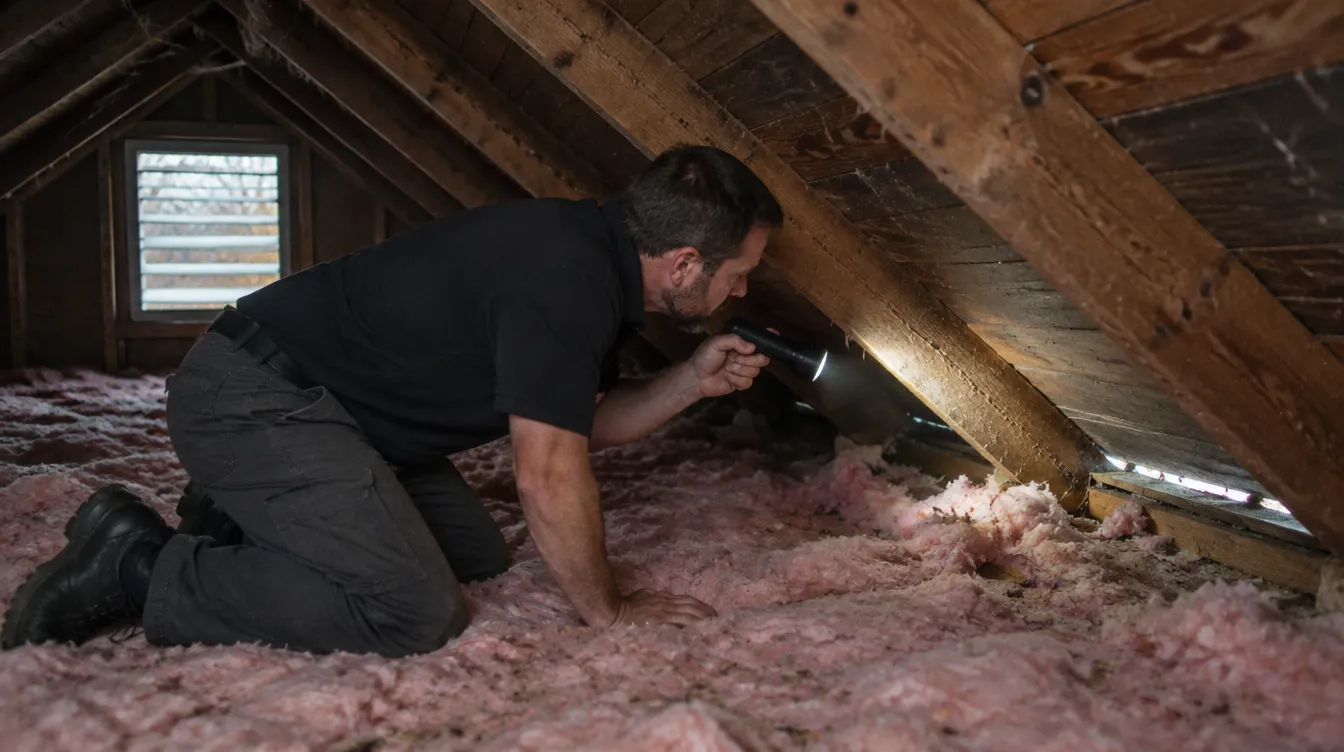
The first week of November is when the phone starts ringing from Windham. The pattern is always the same: a few cold nights, the furnace or woodstove running for real, and then a scratching sound in a bedroom wall or above the ceiling around 10 p.m. Nobody saw a mouse. The noise is the only evidence, and it is enough.
This guide explains what is happening inside the wall, why Windham's housing stock is so easy for mice to get into, what a proper pre-winter rodent inspection covers, and what you can check yourself this weekend. It is written for the homes we actually see here: capes and ranches off Route 302, farmhouses on Windham Center Road and Pope Road, raised ranches in the subdivisions off River Road, and the camps and year-round conversions around Little Sebago, Highland Lake and the Sebago Lake shore. If you want the wider regional picture, our fall rodent exclusion guide for Greater Portland covers the whole service area.
Why mice move into Windham homes in November
Windham is a town of wooded lots, stone walls, field edges and water. That is exactly the habitat house mice and deer mice do well in from May to October. When nights drop into the 30s, the seed and insect supply collapses and every mouse within a hundred feet of a heated building goes looking for the warm air leaking out of it. A house with the heat on is, from a mouse's point of view, a south-facing cliff with food inside.
They do not need an obvious hole. A house mouse fits through a gap the width of a pencil. Deer mice, which are more common on the rural and lakeside lots in town, are slightly bigger, climb better, and are the species most often found nesting in attic insulation and in the walls of camps. Both will follow a warm draft to its source, which is why the entry point is so often somewhere nobody looks: a soffit gap, the hole around a propane line, or the corner where a deck ledger meets the sill.
Once inside a wall cavity, a mouse can run the length of the house along the sill plate, climb inside the wall on wiring and plumbing, and reach the attic through the gaps around chimneys, plumbing vents and recessed lights. That is why the scratching moves. The nest is usually in the attic insulation or a soffit bay; the wall is the highway.
Where mice get into Windham's houses
Different parts of town have different weak points, and the inspection changes with the building.
Capes and ranches (most of Windham Center and the Route 302 neighborhoods)
The classic gaps are the garage. Attached garages are rarely sealed to the same standard as the house: the overhead door has worn bottom seals and daylight at the corners, and the wall between the garage and the house has unsealed penetrations for wiring and the water heater. Once a mouse is in the garage, it is in the house. On capes, the knee-wall spaces behind upstairs bedrooms are the second problem; they connect directly to the eaves and are full of insulation to nest in.
Older farmhouses and the mill-village houses in South Windham and Little Falls
Fieldstone and rubble foundations, stone-faced bulkheads and old sill plates that have pulled away from the foundation. The gaps here are large and numerous, and the fix is less about caulk and more about mortar, hardware cloth and sheet metal at the sill line. These houses also tend to have the woodstove, which means firewood stacked against the house or in the cellar, both of which bring mice in with them.
Raised ranches and split-levels off River Road and Falmouth Road
Watch the junction where the lower-level siding meets the foundation, the dryer vent and the bathroom exhaust vent (missing or broken louvers), and the gap under the bottom step of the front stairs. Decks built against the house hide the sill from view and are a common unsealed route.
Camps and lake houses on Little Sebago, Highland Lake, Forest Lake and the Sebago shore
Pier foundations, skirting with gaps, crawlspaces that open to the ground, and seasonal buildings that sit closed for weeks at a time. If a camp is closed up for the winter, the first visit in spring is when the damage is discovered. If it has been converted to year-round use, the original crawlspace is usually still the weak point. Our Sebago Lake winter rodent guide goes further on seasonal properties.
What a pre-winter rodent inspection actually covers
A real inspection takes most of an hour on an average Windham house and is done in a fixed order so nothing is skipped. This is what ours includes.
- Exterior walk at ground level. Every foot of the foundation, the sill line, bulkhead, utility penetrations (propane, oil fill, electric service, cable, AC lines, hose bibs), dryer and exhaust vents, garage door seals and the base of every door. Gaps are marked and measured.
- Exterior walk at the roofline. Soffit and fascia joints, gable vents and their screens, the gap where roof planes meet, the chimney flashing and any spot where a tree limb or trellis gives a mouse a ladder.
- Garage and basement. Droppings, rub marks (dark grease along a travel route), gnawed stored goods, and nesting material in the bays between joists. The basement ceiling is where you find out which wall the mice are using.
- Attic. Insulation tunnels and nests, droppings concentrated near the eaves, chewed wiring insulation, and staining on the underside of the roof deck. We also check the chases around the chimney and plumbing vents, which is how mice travel between floors.
- Interior. Under sinks, behind the stove and refrigerator, the pantry, the back of closets on exterior walls, and anywhere you have heard noise.
- Written findings and a firm quote. Every entry point goes on a list with the recommended closure material. Pricing is set after the inspection, not before, because no two houses have the same number of gaps.
Rodent work in Maine is exclusion first and trapping second. Baits alone inside a wall produce dead mice inside the wall, which is a smell problem in February. Sealing the exterior and trapping what is already inside is the sequence that holds through winter. Our rodent control service page describes the full program, and the house mice and field and deer mice pages cover how we tell the two apart.
Six things to check yourself this weekend
You do not need a technician to find the obvious gaps. Walk the house with a flashlight on a cold, still evening and look for these.
- Garage door. Close it and stand inside with the lights off. Any daylight at the bottom corners is a mouse door.
- Dryer vent and bath fan hoods. Louvers should close flat. A missing or stuck louver is a four-inch open window.
- Utility penetrations. Where the propane line, oil fill, AC line set and cable enter the house, you want a sealed collar, not a gap packed with old foam.
- Bulkhead. Check the seam between the metal or wood bulkhead and the foundation, and the bottom of the inner door.
- Firewood. Move the stack off the house and off the ground. Bring in only what you will burn in a day or two.
- Bird feeders. Spilled seed under a feeder is a feeding station ten feet from your foundation. Move it away from the house or stop feeding until spring.
Anything you find can be closed with hardware cloth, copper mesh and sealant for small gaps, or sheet metal and mortar for larger ones. Expanding foam on its own does not stop a mouse; they chew through it.
Why it matters more than the noise
Mice in a wall are a nuisance. Mice in an attic for a whole winter are a repair bill. Urine-soaked insulation loses its insulating value and has to be removed. Gnawed wiring insulation is the fire risk most people do not think about until an electrician points it out. And a population that starts as two mice in November is several dozen by March. For Windham homeowners the practical rule is simple: if you hear it in November, deal with it in November.
Frequently asked questions
I hear scratching in the wall at night but have not seen a mouse. Is it really mice?
Usually, yes. Mice are nocturnal and in November the noise is almost always mice or, less often, red squirrels or flying squirrels in the attic. A technician can tell the difference quickly from the droppings and the size of the entry point. Squirrels need a much larger opening and are usually active at dawn and dusk rather than late at night.
Can I just put out traps and skip the inspection?
Traps will catch the mice already inside, but if the entry point stays open you will be trapping all winter. The inspection finds the gaps so the traps become a one-time job instead of a routine.
Do you use bait or poison inside the house?
Inside living space and walls we rely on sealing and trapping. Baits are used selectively in tamper-resistant stations where they make sense, and never where a dead mouse would end up inside a wall or where children or pets could reach them. Every job is explained before it starts.
We have a camp on Little Sebago that we close for the winter. When should we inspect it?
The week you close it. An empty, unheated building is not safer; it is undisturbed. Seal it before you leave and set monitoring traps you can check on a January visit.
How do I know if the mice are in the attic or the walls?
Both, usually. The nest is most often in attic insulation or the eave bays; the wall is how they travel to food in the kitchen. Noise that moves vertically is a sign they are using a wall cavity or a plumbing chase as a route.
What does the inspection cost?
The inspection is free. The quote for sealing and trapping is firm and written after the inspection, because the price depends on how many entry points your particular house has.
Robbins Pest Services is based in Portland and works in Windham every week, including North Windham and the lake neighborhoods. The company holds a Maine Commercial Master Applicator license (CMA-6319). To book a rodent inspection in Windham, call (207) 770-0274 or use the free inspection form.