
By the third week of November most of Greater Portland has had its first hard frosts, the furnaces are running, and the calls change. People stop asking about ticks and wasps and start asking a quieter question: is there something in my house, and how would I know? A pre-winter pest inspection is how you find out before the snow makes exterior work impossible. This guide explains what a proper inspection covers, what it usually turns up in November in Portland, South Portland, Scarborough and Gorham, and what happens afterwards.
If you already hear scratching in a wall, start with our guide to mice in walls and attics. If you want the big-picture seasonal plan, the fall rodent exclusion guide covers the whole service area. This article is about the inspection itself.
Why the inspection happens in November
Two things are true at the same time in late November. Mice, rats, cluster flies and other overwintering pests have already made their move toward heated buildings, so the evidence is fresh and easy to read. And the ground is not yet frozen or buried, so a sill gap, a bulkhead seam or a cracked foundation joint can still be sealed with mortar, hardware cloth and sealant. Inspect in December and you will still find the problem; you just cannot fix the outside of the house until April.
There is a second, less obvious reason. A November inspection catches the first one or two mice. A March inspection catches their grandchildren. Rodent populations that start in a Maine basement in November are a different scale of job by late winter, and the insulation and wiring damage has already been done.
What the inspector actually checks
A thorough home inspection takes most of an hour on an average Greater Portland house and runs in a fixed order so nothing is skipped. Ours covers five zones.
- Foundation and sill line, outside. Every foot of the perimeter at ground level: the joint between foundation and sill plate, bulkhead seams, the gap under every exterior door and the garage door, and every utility penetration (oil fill, propane, electric service, cable, AC line set, hose bibs, dryer and bathroom exhaust vents). Each gap is marked and measured. A house mouse needs an opening about the width of a pencil.
- Roofline, outside. Soffit and fascia joints, gable and ridge vents and their screens, chimney flashing and the spots where roof planes meet. This is where cluster flies and squirrels get in, and where mice climb to the attic along a trellis, a vine or a tree limb that touches the house.
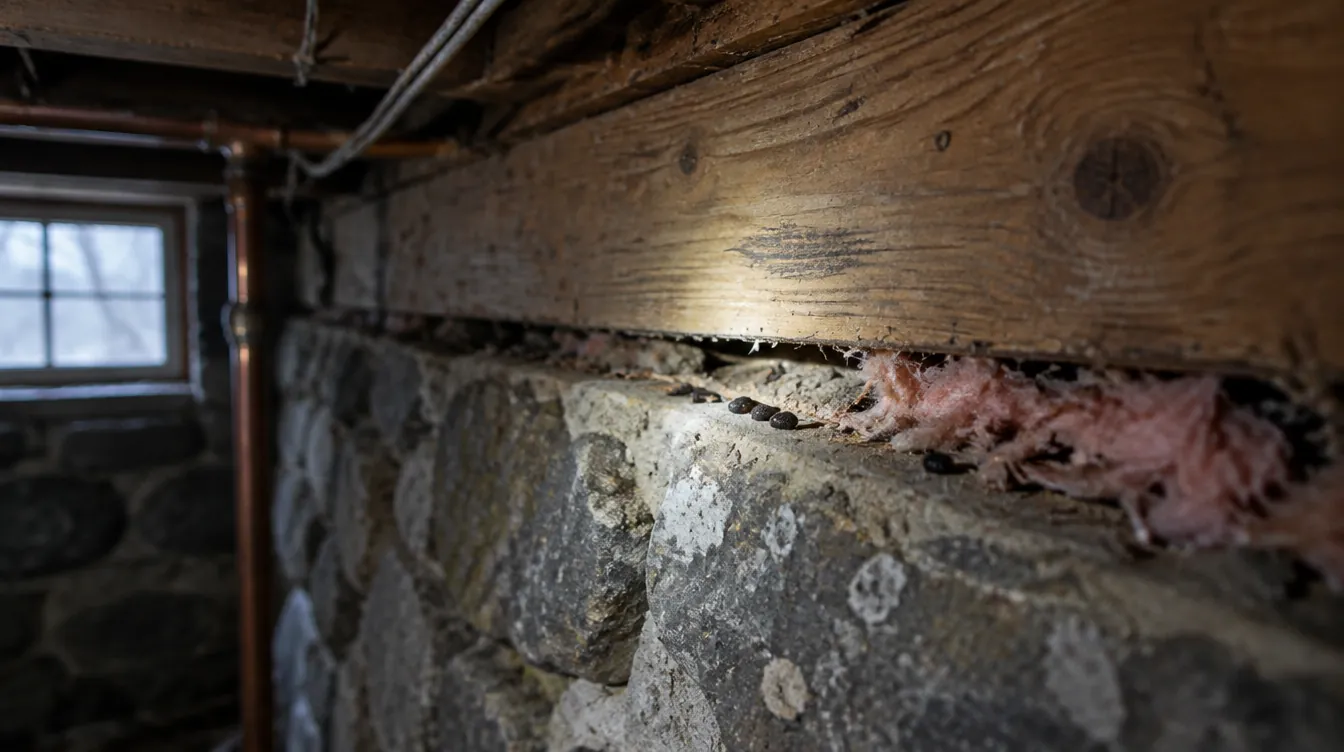
- Basement or crawlspace. Droppings along the wall-floor joint, rub marks (dark grease smears along a travel route), gnawed stored goods, nesting material tucked between joists, and daylight showing through the sill from inside. The basement ceiling tells you which wall the mice are using to reach the kitchen.
- Attic and knee walls. Tunnels in loose insulation, droppings concentrated near the eaves, chewed wiring insulation, staining on the underside of the roof deck, and the open chases around the chimney and plumbing vents that let rodents travel between floors.
- Living space. Under the kitchen sink, behind the stove and refrigerator, the pantry, the backs of closets on exterior walls, and anywhere the homeowner has heard noise or seen a single dropping.
Some inspections also include a look at the yard: woodpiles against the house, bird feeders dropping seed near the foundation, compost bins, and chicken coops, all of which hold a rodent population within a few feet of the siding.
What a November inspection usually finds in Greater Portland
The findings follow the housing stock more than the town line, but each part of the area has its pattern.
Portland's older neighborhoods
In the West End, Munjoy Hill and Deering the common finding is a brick or fieldstone foundation with failed mortar at the sill, plus a cellar bulkhead that has never sealed properly. Multi-unit buildings add shared wall cavities and basement utility rooms where one unit's problem becomes the building's problem.
South Portland
The mid-century capes and ranches in South Portland most often show gaps at the attached garage: a worn bottom seal on the overhead door and unsealed penetrations in the wall between the garage and the house. Homes near the water also see Norway rats working along shorelines and storm drains, which the inspection looks for at ground level.
Scarborough
Newer subdivisions in Scarborough tend to be tight at the foundation but leak at the roofline: missing vent screens, soffit gaps and deck ledgers that hide the sill from view. Houses on the marsh edges see more field and deer mice than house mice.
Gorham and the farm roads
In Gorham the farmhouses and barns bring the classic rural findings: large sill gaps over rubble foundations, firewood stacked against the house, and feed stored in outbuildings that keeps a rodent population going all winter. Cluster flies on sunny south walls are a frequent November finding here too.
Across all four towns the November list is consistent: mice (house mice in town, deer mice toward the edges), occasional Norway rats near water and compost, cluster flies and stink bugs in attics and window frames, and sometimes a carpenter ant satellite colony in damp framing near a leak. Termites are rare in Maine; carpenter ants are the wood-damaging pest here, and the inspection checks sill plates and window frames for their sawdust-like frass.
What happens after the inspection
You get a written list of findings: every entry point with its location and the recommended closure material, any active pest evidence and where it was found, and the moisture or structural conditions that are feeding the problem. From that list comes a firm written quote. Pricing is set after the inspection, never before, because no two houses have the same number of gaps.
If you go ahead, the work follows the order that holds through a Maine winter: seal the exterior first, then trap what is already inside. Small gaps are closed with copper or stainless mesh and sealant; larger ones with hardware cloth, sheet metal or mortar. Expanding foam on its own does not stop a mouse. Inside, snap traps go on the travel routes the inspection identified. Rodenticide is used selectively in tamper-resistant stations outdoors where it makes sense, and never where a dead mouse would end up inside a wall. The rodent control page describes the full program.
Many homeowners then move to a preventative maintenance plan, which repeats the inspection on a schedule and reseals anything that opens up as the house moves through freeze and thaw. For households that only want the one visit, the inspection and sealing stand on their own.
Pre-winter inspection versus a real estate inspection
People sometimes confuse the two. A real estate pest inspection is written for a closing: it documents the presence or absence of wood-destroying pests and is tied to a transaction date. A pre-winter inspection is for the people living in the house right now, and it is about entry points and current activity rather than paperwork. If you are buying a Greater Portland home this winter you may want both.
Five things to check yourself before you call
- Stand inside the closed garage with the lights off. Daylight at the bottom corners of the door is a mouse door.
- Check that the dryer vent and bathroom fan hoods have louvers that close flat.
- Look at where the oil fill, propane line and cable enter the house. You want a sealed collar, not old foam.
- Move firewood off the house and off the ground, and bring in only a day or two's supply at a time.
- Move bird feeders well away from the foundation, or pause feeding until spring.
Anything you find is worth noting for the inspector; anything you cannot reach or explain is what the inspection is for. Our general pest control page covers the wider range of pests the same visit can address.
Frequently asked questions
How long does a pre-winter pest inspection take?
Usually 45 minutes to an hour for an average single-family home in Greater Portland. Larger or older houses with several outbuildings take longer. You will get the written findings the same visit.
Do I need to be home for the inspection?
For the exterior and basement, no, as long as we have access. For the attic and living space, yes, and it helps if you can point out where you have heard noise or seen droppings.
Is the inspection free?
Yes. The inspection and the written findings are free. The quote for sealing and trapping is firm and written after the inspection, because the price depends on how many entry points your house has.
What if the inspection finds nothing?
That happens, especially in newer, tight houses. You still get the list of the few places to keep an eye on, and the five do-it-yourself checks in this article cover the rest.
Can an inspection be done after it snows?
The inside of the house can be inspected any time. Exterior sealing at the foundation has to wait until the ground is clear, so a December or January inspection usually ends with interior trapping now and exterior work in spring.
Is this the same inspection you do for a home sale?
No. A real estate pest inspection documents wood-destroying pests for a closing. A pre-winter inspection is about current activity and entry points for the people living in the house. We offer both.
Robbins Pest Services is based in Portland and inspects homes across Greater Portland every week, including Portland's neighborhoods, South Portland, Scarborough, Cape Elizabeth, Westbrook, Gorham and Windham. The company holds a Maine Commercial Master Applicator license (CMA-6319). To book a pre-winter inspection, call (207) 770-0274 or use the free inspection form.