
Most people in Greater Portland think of ticks as a May-and-June problem. Then the leaves turn, the air cools, and the tick checks stop. That is exactly when adult deer ticks become most active. In southern Maine the adult blacklegged tick (the deer tick, Ixodes scapularis) has a second surge that starts in late September, peaks through October and November, and keeps going until the ground freezes hard. If you walk trails in Cape Elizabeth, rake leaves in Westbrook, or let the dog out on a wooded lot in Windham, fall is not the end of tick season. It is the second half of it.
This guide covers why fall ticks are different, where they hide on a typical Greater Portland property, what actually reduces them, and when a professional yard treatment makes sense.
Why adult deer ticks surge in the fall
Deer ticks live about two years and feed once at each stage. The nymphs that cause most spring and summer bites are the size of a poppy seed. By fall those nymphs have molted into adults, and adult females need one more blood meal before they lay eggs the following spring. That drives them up onto grass tips and leaf litter from roughly late September onward, questing for a deer, a dog, or a person walking past.
Two things make the fall surge easy to underestimate. Adults are larger than nymphs and easier to spot, so people assume they are less of a threat, but adult females carry the Lyme bacterium at a higher rate because they have already fed once. And cold does not stop them: adult deer ticks are active any day above freezing without snow cover, which in coastal Cumberland County can mean warm spells into December and again on thaw days in March. American dog ticks are mostly done by August, so a tick found in October in Greater Portland is almost certainly a deer tick.
Where ticks live on a Greater Portland property
Ticks do not live in the middle of a sunny lawn. They dry out quickly and need shade and humidity, so they concentrate in a fairly predictable band on most properties in our area:
- The edge zone where mowed lawn meets woods, tall grass, or an unmowed field. On a Gorham or Standish lot backing onto woods, this edge is the single highest-risk strip on the property.
- Leaf litter. Fallen oak and maple leaves left under trees, along stone walls, and in the corners where the fence meets the shed hold moisture and shelter ticks through the winter.
- Stone walls and woodpiles. Old New England stone walls are mouse highways, and white-footed mice are the main reservoir for Lyme in Maine. Where the mice are, the young ticks feed.
- Ornamental plantings and groundcover against the house. Dense pachysandra, ivy, and low shrubs in the shade on the north side of a house stay damp all fall.
- Deer paths. If deer cross your yard in Cape Elizabeth, Falmouth, or Scarborough, they drop adult ticks along the same route every time.
A quick check: drag a white towel slowly across the leaf litter and edge zone on a mild afternoon. If you pick up adults in October, the yard is supporting a population, not just occasional visitors.
What actually reduces ticks in the fall
Clean up the leaf litter, and do not pile it at the edge. Raking and removing leaves from the lawn edges, under shrubs, and along the foundation takes away the humid layer adult ticks overwinter in. Piling the leaves at the tree line just moves the habitat closer to where you walk. Bag them, compost them well away from the yard, or use municipal leaf pickup where your town offers it.
Mow one last time and cut back the edge. A final short mow in late October and a string-trimmer pass along the woods line, fence lines, and stone walls exposes ticks to sun and dry air. Keep the ornamental beds against the house trimmed up off the ground.
Create a dry barrier. A three-foot band of wood chips or gravel between the lawn and the woods is a tick-control method backed by university extension research, not a folk remedy. Ticks avoid crossing hot, dry ground. It works best on properties in Windham, Raymond, and the Sebago Lake area where a lawn butts straight into woods.
Manage the mice. This is the part most homeowners skip. Adult deer ticks feed on deer, but the larvae and nymphs that will bite you next spring are picking up Lyme from mice this fall. Sealing the house against rodents, moving woodpiles off the ground and away from the house, and keeping bird seed cleaned up all cut the mouse population that feeds next year's ticks. Fall rodent exclusion and fall tick control are really the same project, which is why we often do both on one visit.
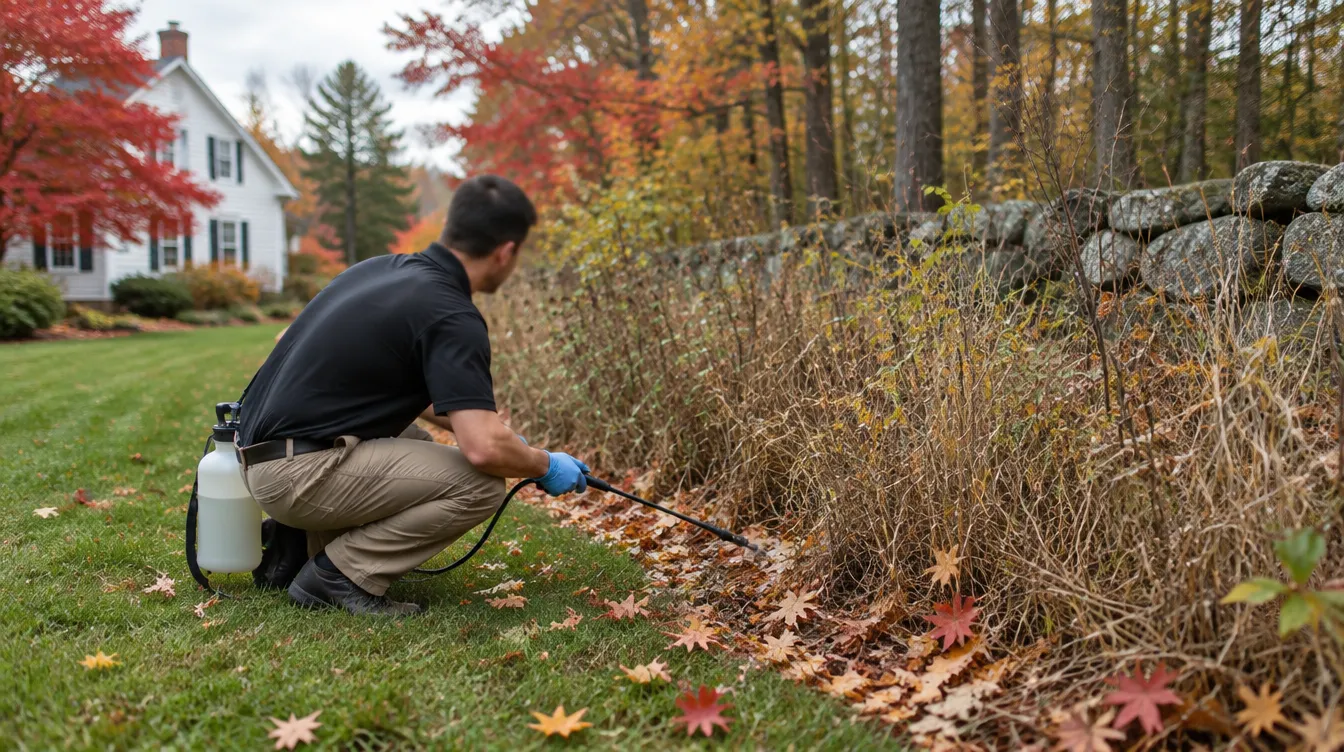
Treat the edge zone, not the whole yard. A professional fall tick treatment targets the transition strip where ticks actually quest: the perimeter of the lawn, the leaf litter under trees, stone walls, and shaded plantings. It is not a blanket spray across the open lawn, because ticks are not there. In Greater Portland the most effective window for a fall application is late September through October, while adults are active and before leaves fully bury the litter layer.
What a professional fall tick treatment involves
When Robbins Pest Services does a fall tick treatment on a property in Greater Portland, the visit starts with a walk of the perimeter to identify the actual harborage: where the lawn edge is, where the leaf litter collects, where deer and mice are moving. We then apply a targeted treatment to those zones. Depending on the property and your preference, that can be a conventional residual product or an organic option; both are applied to the edge habitat and not to areas where people and pets spend most of their time.
We also point out what a treatment cannot fix on its own, such as an unmowed field, a leaf pile at the tree line, or a woodpile against the foundation. For properties with recurring pressure, a seasonal program with spring, summer, and fall applications keeps the population down year over year. Pricing depends on the size of the treated perimeter and the amount of edge habitat, so we give a firm quote after a free inspection rather than a flat number over the phone.
Protecting your family and pets through the fall
Fall means more time outdoors around Portland: soccer fields, the trails at Robinson Woods and Fort Williams in Cape Elizabeth, the Presumpscot River trails in Westbrook, hunting season in the Lakes Region. A few habits matter more in October than in July:
- Do a full tick check after any time outdoors, including after raking your own yard.
- Run outdoor clothes through a hot dryer for ten minutes before washing; heat kills ticks, a cold wash does not.
- Keep dogs on their tick preventive through December, not just through summer.
- Remove an attached tick with fine-tipped tweezers pulled straight out and note the date. The University of Maine Tick Lab accepts ticks for identification and testing.
Frequently asked questions
Are ticks really still active in October in Maine?
Yes. Adult deer ticks are most active in Greater Portland from late September through November and remain active on any day above freezing without snow cover. October is the second peak of the year for deer tick encounters in southern Maine.
Is it too late to treat my yard for ticks in the fall?
No. A fall application in late September or October targets the adult deer ticks that are questing now and reduces the number of females that will lay eggs in spring. It is one of the two most effective times of year to treat, along with late spring.
Does a fall tick treatment also help with mosquitoes?
Mosquito season in Greater Portland is essentially over by the first hard frost, so fall treatments focus on ticks. Our combined mosquito and tick programs run from spring through early fall; the fall visit is tick-specific.
Where should I look for ticks on my property?
Concentrate on the strip where lawn meets woods or tall grass, leaf litter under trees and along stone walls, shaded groundcover against the house, and anywhere deer cross the yard. Ticks are rarely in the middle of a sunny, mowed lawn.
Will a yard treatment hurt my dog or my kids?
Treatments are applied to edge habitat and leaf litter where ticks live, not to play areas or the open lawn, and we advise a short re-entry period after application. Organic options are available. Your technician will walk through the treated zones with you before leaving.
How does rodent control connect to ticks?
White-footed mice are the main source of Lyme bacteria for young ticks in Maine. Sealing mice out of the house and reducing harborage like woodpiles and dense groundcover lowers the number of infected ticks on your property next year. Fall is the right time for both.
Ready for a fall tick treatment?
If you are finding ticks on the dog, the kids, or yourself this fall, or your property backs onto woods anywhere in Greater Portland, Robbins Pest Services can inspect the yard and give you a firm quote for a targeted fall tick treatment. Call (207) 770-0274 or request a free inspection online. Learn more about our flea and tick treatment.
By Robbins Pest Services